
If you are booking between May 15th and August 15th, please see the SUMMER page to see what shows are available.
STEM is Science, Technology, Engineering, and Math—focused on problem‑solving and technical skills. STEAM adds the Arts, blending creativity with innovation.
Everyone loves LEGO, and our STEAM labs are the perfect way for kids to learn while having a blast! Each lab boasts over fifty pounds of LEGO, sparking excitement as soon as the bags are opened. You’ll hear the kids’ delighted gasps and shouts of joy as they exclaim, “These are the most LEGOs I’ve ever seen!” But there’s more—these labs also include unique LEGO sets that enhance the learning experience, setting them apart from the standard free play offered at schools or libraries. Don’t miss out on this exceptional opportunity for your child to engage with STEM concepts in a fun and creative way!
LEGO STEAM Minifigure Lab
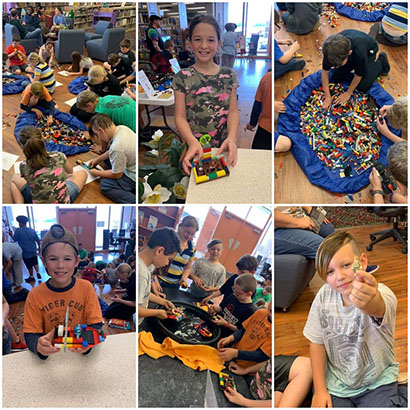
Get ready for an unforgettable LEGO experience! In this workshop, kids can let
their imagination soar by creating their very own unique LEGO minifigure and
putting it through three exciting challenges. With enough parts to create over
three hundred different minifigures, your child will have endless possibilities
to craft a character that is entirely their own. Plus, the best part is that every
time a child creates a minifigure, they get to give it a unique biography,
turning it into their very own friend.
But the fun doesn’t stop there! After crafting their new companion, the
children’s LEGO friends will go through three exciting STEAM challenges. And
the best part? Children are allowed to proceed at their own pace, so they can
take their time and enjoy every moment of this thrilling experience.
This workshop is perfect for children aged six and up, but even tweens and
teens will love it! With all materials provided, there’s no need to worry about
anything. Just come ready to have fun and to let your creativity run wild! Please note that children will not be able to take their minifigures home, but
they will leave with unforgettable memories that will last a lifetime.
STEM EDUCATIONAL STANDARDS
Crosscutting Concepts
Scale, proportion, and quantity, Structure and function, Cause and effect: Mechanism and explanation, Scale, proportion, and quantity
Science and Engineering Practices
Asking questions and defining problems
Developing and using models
Planning and carrying out investigations
Obtaining, evaluating, and communicating information
Vocabulary
Area, Float, Force, Load, Sail, Sink, Stable, Unstable, Stable, Unstable, Load, Weight, Fair, testing, Measuring, Safe, Balance, Mass, Position, Weight,
Common Core State Standards for Mathematics
Mathematical Practice
MP1 Make sense of problems and persevere in solving them
MP5 Use appropriate tools strategically
MP6 Attend to precision
MP7 Look for and make use of structure
Measurement & Data
K.MD.A / 1.MD.A / 1.MD.C / 2.MD.A / 2.MD.D
Writing Standards
W.K.2 / W.1.2 / W.2.2
Speaking and Listening
SL.K.3 / SL.K.6 / SL.1.3 / SL.1.5 / SL.2.1 / SL.2.3
LEGO STEAM Race Car Lab
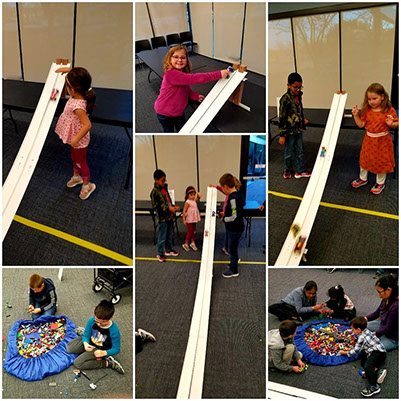
Looking for a fun and educational way to spark your children’s curiosity about the science behind movement? This amazing lab is just what you need! Tailored for children aged six and up, it features fifty pounds of LEGO and an impressive thirty-foot-long racetrack that will captivate their imaginations. Through hands-on investigations, kids will dive into concepts like gravity, inertia, friction, and push/pull while enhancing their STEAM skills. The excitement of racing their cars on the track will make learning feel like play, ensuring they grasp complex scientific principles without even realizing it! This interactive lab is also a hit with tweens and teens, so it’s perfect for family bonding time. Don’t miss this incredible opportunity to learn, explore, and have a blast together—everything you need will be included!
STEM EDUCATIONAL STANDARDS
Crosscutting Concepts
Patterns
Cause and effect: Mechanism and explanation
Scale, proportion, and quantity
Science and Engineering Practices
Asking questions and defining problems
Developing and using models
Planning and carrying out investigations
Using mathematics, Informational and Computer Technology, and computational thinking
Obtaining, evaluating, and communicating information
Common Core State Standards for Mathematics
Mathematical Practice
MP1 Make sense of problems and persevere in solving them
MP2 Reason abstractly and quantitatively
MP4 Model with mathematics
MP5 Use appropriate tools strategically
MP6 Attend to precision
MP7 Look for and make use of structure
Measurement & Data
K.MD.A / 1.MD.A / 1.MD.C / 2.MD.A / 2.MD.D
Writing Standards
W.K.2 / W.1.2 / W.2.2
Speaking and Listening
SL.K.1 / SL.K.3 / SL.K.5 / SL.K.6 / SL.1.1 / SL.1.3 / SL.1.5 / SL.2.1 / SL.2.3 / SL.2.4
The Bubble STEM Lab
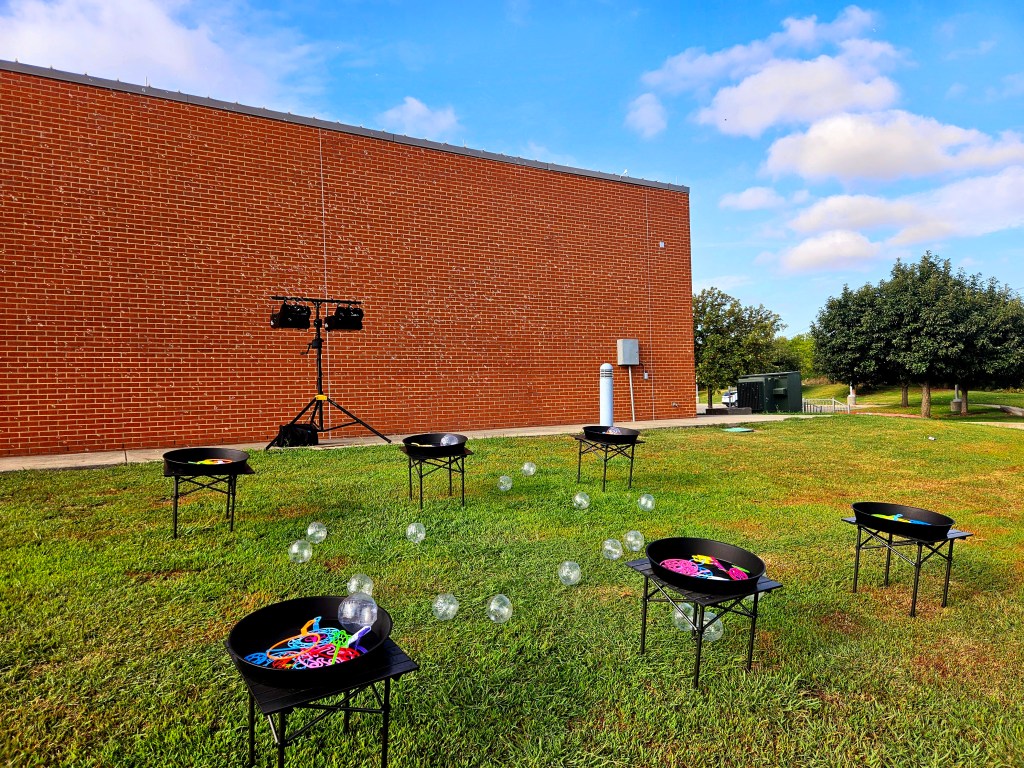
Join in the wonder of bubbles! The Bubble STEM Lab is an exciting and interactive bubble playground designed to spark curiosity and joy in children. Our DJ quality bubble machines will fill the area with countless bubbles for kids to play with and explore. With six bubble centers featuring a variety of bubble fluid and toys, children can engage in hands-on learning about the fascinating science of bubbles. The atmosphere is enhanced with clear beach balls that resemble giant bubbles, and the kids can enjoy lively, bubble-themed music like “Under the Sea” and “Yellow Submarine” while they play. The experience not only provides fun but also fosters the development of motor skills in younger children and scientific knowledge in older children. Join us for an unforgettable hour of discovery and delight.
STEM Educational Standards Connections
Science (NGSS)
- Physical Science (PS1, PS2):
- Explore matter and its interactions through bubble fluid ingredients and surface tension.
- Investigate forces and motion by observing how bubbles float, rise, and pop.
- Earth & Space Science (ESS2):
- Observe how air pressure and gases affect bubble formation.
- Scientific Practices:
- Children ask questions, make predictions, and test bubble solutions (scientific method).
- Record observations (size, shape, longevity of bubbles) to analyze patterns.
Technology
- Use of Bubble Machines:
- Demonstrates how tools and technology enhance experiments.
- Encourages children to compare machine-made bubbles vs. hand-made wands.
Engineering
- Engineering Design Standards (ETS1):
- Kids can design and test bubble wands of different shapes and materials.
- Apply iterative design: hypothesize, build, test, and refine.
- Problem-Solving:
- Challenges like making square or cube-shaped bubbles encourage creative engineering.
Mathematics
- Geometry & Measurement:
- Identify shapes (spheres, cubes, cylinders) in bubble experiments.
- Estimate and measure bubble diameters, lifespans, and counts.
- Patterns & Data:
- Record bubble outcomes and compare across different fluids or tools.
Early Childhood Development
- Motor Skills:
- Younger children develop gross motor skills by chasing and popping bubbles.
- Sensory & Cognitive Growth:
- Older children engage in critical thinking, experimentation, and problem-solving.
 Brett Roberts Productions